

















































Emma by Jane Austen - Free eBook
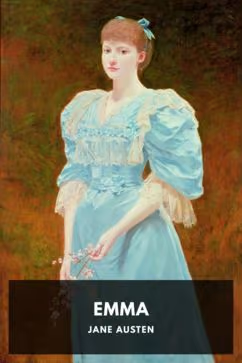
In the realm of classic literature, few novels have captured the imagination quite like Jane Austen’s Emma. First published in 1815, this story of love, mischief, and self-discovery continues to resonate with readers today. Set in the idyllic village of Highbury, the narrative follows the life of Emma Woodhouse, a young woman blessed with beauty, wealth, and a keen intellect. Yet, despite her many advantages, Emma is also a character plagued by her own misconceptions and misguided attempts at matchmaking.
From the outset, readers are introduced to Emma’s charming yet flawed personality. She is determined to play the role of a matchmaker, believing herself to possess an innate talent for pairing off her friends and acquaintances. Her most notable project is Harriet Smith, a sweet but impressionable girl of uncertain parentage. Emma’s misguided attempts to elevate Harriet’s social standing lead to a series of misunderstandings and complications, revealing Emma’s own flaws and the limitations of her judgment.
One of the most intriguing aspects of Emma is its exploration of personal growth. Throughout the novel, Emma undergoes a significant transformation as she navigates the complexities of love and friendship. Her initial confidence in her abilities is challenged as her plans unravel, forcing her to confront the consequences of her actions. The evolution of her character is a testament to Austen’s keen understanding of human nature and the capacity for change.
Emma’s relationship with Mr. Knightley, her close friend and eventual love interest, serves as a catalyst for her self-reflection. Mr. Knightley is a voice of reason, often serving as a moral compass for Emma. His honest critiques of her behavior push her to reassess her motivations and the impact she has on those around her. Their banter and mutual respect create a dynamic that is both entertaining and thought-provoking, adding layers to the narrative.
Austen’s keen observations extend beyond Emma’s personal journey. The social fabric of Highbury is rich with a diverse cast of characters, each contributing to the narrative’s exploration of class, gender, and societal expectations. From the pompous Mr. Elton to the kind-hearted Miss Bates, these characters enrich the story and provide insight into the era’s social dynamics. Austen’s wit and sharp commentary on the absurdities of social standing are as relevant today as they were in the early 19th century.
The novel also delves into themes of love in its various forms. Emma’s initial misunderstandings of love and attraction are contrasted with the genuine affection seen in other relationships, such as that of Mr. and Mrs. Weston. Through the lens of romance, Austen examines the difference between superficial attraction and deep emotional connections. Emma’s journey ultimately leads her to a more profound understanding of love, culminating in her relationship with Mr. Knightley, which is built on mutual respect and understanding.
Emma’s charm lies not only in its engaging plot and well-drawn characters but also in Austen’s masterful prose. Her use of irony, humor, and social commentary adds depth to the narrative, inviting readers to reflect on their own perceptions of love and relationships. The novel’s rich language and vivid descriptions transport readers to a world of Georgian England, where the nuances of society are carefully dissected.
As we revisit Emma in the modern age, it is clear that Austen’s insights into human behavior are timeless. The themes of self-discovery, the complexities of love, and the pitfalls of social ambition continue to resonate with readers across generations. Emma Woodhouse may be a character of her time, but her journey of growth and understanding is universal.
In conclusion, Jane Austen’s Emma remains a beloved classic for its blend of humor, romance, and social critique. It is a story that invites reflection on the nature of love and the importance of personal growth. As we accompany Emma on her journey, we are reminded of the complexities of human relationships and the enduring power of self-awareness. Emma may have been written over two centuries ago, but its lessons remain relevant, making it a timeless treasure in the literary canon.
The main character, Emma Woodhouse, is described in the opening paragraph as ''handsome, clever, and rich'' but is also rather spoiled. As a result of the recent marriage of her former governess, Emma prides herself on her ability to matchmake, and proceeds to take under her wing an illegitimate orphan, Harriet Smith, whom she hopes to marry off to the vicar, Mr Elton. So confident is she that she persuades Harriet to reject a proposal from a young farmer who is a much more suitable partner for the girl.